How to turn failure into success
The pro’s and con’s of lay betting.
Many’s the time over the past 30 years that I’ve worked in this industry, when I’ve been asked about “laying services”.
Whether this concerns horseracing tips, for the most part, or other sports… I have been approached by potential content providers, as well as asked by numerous members, whether I operate syndicates which handle lay bets, or those which have a focus on trying to get horses/teams/players beaten (as opposed to backing them to win).
Because this is what “lay” betting is all about at the end of the day, backing something not to happen.
Tiger Roll not to win the Grand National.
Manchester United not to win the Premier League.
Rory McIlroy not to win the US Masters.
And if they don’t, then you collect your winnings.
So you kind of get to play God, or bookmaker – same thing really! – and hold the fate of the market in your own hands.
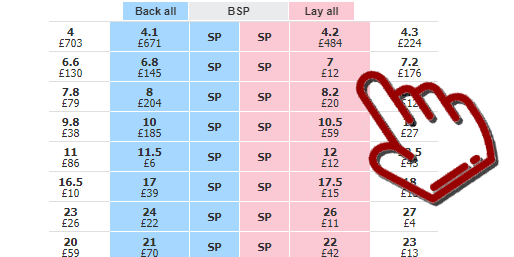
Better news still… in the modern day, with the advent of the likes of Betfair, and the other betting exchanges, you can lay a horse, football team, or golfer as easily as you can back one – with a simple click of a pink, rather than blue, box.
Wind the clock back, and the only way to lay anything was with the High Street firms, and this was only achieved by physically backing every other runner in the market!
Creating a lay bet by default, almost.
No great shakes in a football match (with just 3 outcomes) or, say, a 6-runner horserace… but a golf tournament? Forget it.
So the exchanges have made laying an extremely easy and straightforward process which, potential skullduggery aside, is most definitely a good thing.
Why it’s ok to lay
There are many and various advantages to placing lay bets. And these do make the practice, at least on paper, a serious consideration for any committed, or even amateur, backer/trader.
One of the biggest draws to placing lay bets is that you effectively turn the field on its head, and instead of backing one horse out of the dozen who might go to post, or one single golfer from a field of 156 starters in a PGA Tour golf tournament… you’re actually backing everything else, all at the same time.
In effect, you have 11 of the 12 horses in that race (91.66%) on your side.
Better still, you’re on 99.36% of the golfers in the field. And if any one of the 155 win, then you’re in the money.
So rather than looking for the needle in the haystack…
You’ve just got to find the haystack!
And how hard can that be – right?
Well, this is the beauty of lay betting. It’s primary attraction, and the reason why punters get drawn into this style of operating.
You only have to locate one bad bet, or a single piece of poor value, in order to create a potentially winning scenario.
I guess the way to put it best would be…
For a bet to win, everything has to go right. But for a bet to lose… only one thing need to go wrong.
And this makes perfect sense.
Lay betting also provides backers with the ability to arb.
Now arbitrage is another subject, for another day. But the two elements to this profitable betting strategy are (i) a back bet and (ii) a lay bet.
Again, being able to easily lay runners, in a wide variety of markets, makes the idea of arbing a much more attractive proposition.
Then there’s also trading out. A delayed arb, if you like.
For example…
Back golfer at 100/1 pre-tournament, and he leads the field going into the back-nine on Sunday.
Here some backers, depending on their risk profile, would prefer to guarantee themselves a tidy return should he fail to convert this advantage into the win.
A simple lay bet, at the now vastly reduced odds (presumably), would mean they walk away with a handsome return whether said golfer ends the day lifting the trophy, or snapping his clubs!
Yes, I appreciate that the conventional firms have cottoned onto this by offering a “cashout” facility, but my belief is that such gestures are made very much on their terms.
A lay bet is something which gives you (the backer) more control in terms of when/how you trade out of a potentially winning position.
Cashouts sometimes appear to have the purpose of buying you out of a situation that you’d have been better sticking with. An easy temptation to cut-and-run, taking the money, when a more measured strategy might be best.
But, again, the pro’s and con’s of cashouts we can come back to some other time.
Lay bets, used in isolation, remain a very handy tool in their own right.
So what’s not to like..?
Listen, I don’t have any beef with the practice of lay betting. Because in skilled hands, it’s a highly lucrative weapon in the punter’s armoury.
However, there are a few points to make on the other sides of the argument.
To start with, and just touching on the last point for this particular betting method… a haphazard approach to laying (or trading out) could cost you profits when you consider the long-term.
For example, the 100/1 golfer mentioned above sticks his approach on the 18th into the water, loses the tournament by a single shot.
You laid the bet off… so walk away counting your money, and thinking you did the right thing.
But next time, you’re on an under-the-radar 200/1 shot, that’s leading the field with a few holes to go…
“Ah, right…” you say to yourself given past experience, “…time to lay this guy”.
You proceed to hedge/trade/lay your position.
And then he goes and wins.
Chances are if you’d kept both positions open, you’d be better off overall.
And aside from the mental anguish of passing up a winner-of-a-lifetime, you’ve also burned a whole lot of cash to boot. Not good.
Other “not good” situations occur when punters start laying bets, and (God forbid) they win.
Because back a bet to win for a stake of £25, and it loses. You’ve done in £25.
Lay a player at 5.0 on the exchanges, and he wins. You’ve just blown £100.
And I’ve seen this time and again with potential content providers who proof bets to me, and it all seems to be going well…
But then they start laying bets at 8/1, or 12/1 or 16’s…
It’s a 16/1 chance. Slim chance of it landing.
Nope, it wins.
That’s 16 points gone off the P&L in a flash. 16 times whatever stake you place on that unfancied runner that wins (and 16/1 bets do win from time-to-time).
The mathematics of laying, which again I’ll not detour into right now, mean you tend to win small and often. Great, you might think.
But the flipside is that you can lose big. Real big. And should you catch the wrong horse on the wrong day, or lay a couple of football teams back-to-back who just so happen to pull out a couple of against-the-form performances…
All your hard-earned profit is gone in the blink of an eye.
Excuse the French, but the expression in trading circles is, “eat like chickens and shit like elephants”.
And in betting **it does happen.
So you can rack up a long line of winners, get that strike rate at 60%, 70%, or more (and I’ve seen this, as I’m sure you have)… but a couple of losers can cut you off at the knees.
Bank. Gone.
There’s also another very real point, but one which I can’t illustrate by quoting figures.
But it’s something I’ve said to many members, and possible collaborators in the past.
And this is the feeling you get from backing a winner… it far and away outstrips any sensation you get when you succeed with a lay bet.
Each one generates a profit. The lay bet might even return you a greater amount of cash.
But it still doesn’t provide the same buzz. That sense of satisfaction of a job well done.
Impossible to assign it with a monetary value. However, I’m sure you understand exactly what I mean… there’s no feeling quite like backing a winner.
This maybe explains why, commercially speaking, I’ve never offered a lay service. There’s simply not a huge demand for it. Profits or not.
To lay, or not to lay
There are cases when a lay bet seems, and is, the best way to play it.
Similarly, there are times when adopting such a strategy (whilst maybe providing a short-term profit) might cost you a long-term loss.
What I do like is the ability with which the market, and especially Betfair, gives you the option to almost switch horses mid-race. This is a quantum leap forward when compared to the betting Stone Age that I first encountered in the early 1990’s.
And in the hands of a skilled operator, laying can be a hugely profitable pursuit. Whether used in isolation, or in conjunction with standard betting.
But I would urge you to always question why you’re laying a bet. And whether this practice is costing you money over the long run, simply as a means of keeping you happy in the here and now.
Do paper-trade, or keep a note of the times when you do (or might feel tempted) to lay off. Just to see if it really would benefit you in the long-term.
My guess is that it might not always prove to be the best approach.
OPINION: It’s easy to confuse the two uses of this type of bet. One is to lay, only, in its purest form. Locate poor value, vulnerable favourites, and bad bets… and take them on. And it’s never been easier to do this than now. Practice it, perfect it, and it can work – unquestionably. The other use is to trade out, or hedge, a winning position. My word of caution here is don’t get caught between two stools, and randomly give away hard-won profits with a scattergun strategy of sticking here, twisting there.