The Most Costly Mistake in Betting
The Gambler’s Fallacy: Why your brain is constantly trying to lie to you
Every punter has felt it. You’re watching the roulette wheel spin for the eighth time, and red has come up every single time.
Surely…
Surely…
Black is due.
The universe owes you black. Logic demands it. You push your chips onto black with the kind of quiet confidence that only comes from feeling the laws of mathematics on your side.
You lose.
Welcome to the Gambler’s Fallacy! One of the most deeply embedded, financially destructive, and utterly persistent cognitive biases in the world of betting and gambling.
Also known as the Monte Carlo Fallacy, it is the erroneous belief that if a random event has occurred more frequently than expected in the past, it is less likely to occur in the future, or vice-versa.
As Daniel Kahneman, a Nobel Prize-winning psychologist, and author of “Thinking, Fast and Slow” put it…
“The most common source of poor decision-making in gambling is the assumption that past random events affect future random events.”
So understanding this phenomena could be the single most valuable thing you ever do as a punter.
What Exactly Is the Gambler’s Fallacy?
The Gambler’s Fallacy is a logical error rooted in a misunderstanding of independent probability events.
An independent event is one where the outcome is not influenced by any previous outcome. The toss of a coin, a spin of a roulette wheel, and the roll of a dice are all classic examples.
The mathematical truth is straightforward. Let’s take a coin toss.
P(Heads) = 0.5 on every single toss, regardless of history
This means that whether a coin has landed heads 3 times or 300 times in a row, the probability of the next toss being heads remains exactly 50%. The coin has no memory. The roulette wheel has no conscience. The universe is not keeping score.
Getting all mathematical for a moment, for any sequence of n independent events, the probability of each event remains:
P(Event on toss n) = P(Event on toss 1)
The fallacy occurs the moment a bettor believes otherwise.
Monte Carlo: Where the Fallacy Gets Its Name
The name “Monte Carlo Fallacy” was cemented by one of gambling history’s most famous anecdotes.
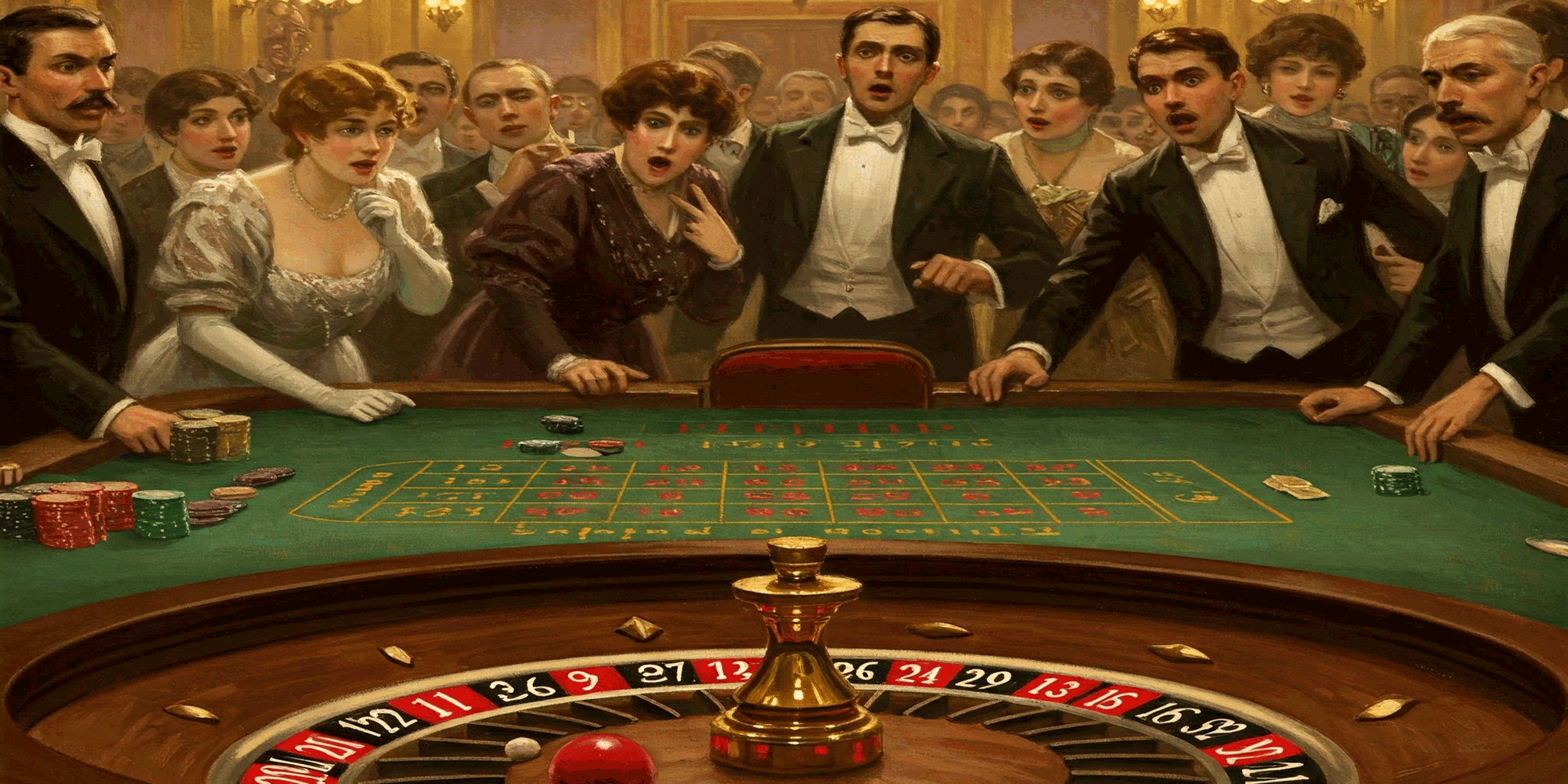
On 18th August 1913, at the Casino de Monte-Carlo in Monaco, the roulette ball fell on black an astonishing 26 consecutive times. As the streak continued, gamblers crowded the table and began betting enormous sums on red, convinced that the “correction” was imminent.
The probability of black appearing 26 times in a row on a European roulette wheel (which has 18 black slots out of 37 total) is approximately:
(18/37)²⁶ ≈ 1 in 136 million
It was extraordinarily rare. But here’s the critical point… after 25 blacks, the probability of the 26th spin being black was still:
18/37 ≈ 48.6%
No different from the very first spin. The casino won a fortune that night, not because luck was on its side, but because human psychology was.
The Fallacy in Sports Betting
The Gambler’s Fallacy doesn’t stay confined to the casino. It seeps deeply into sports betting, where it does considerable damage.
Suppose a Premier League team has lost five consecutive matches. Many backers will begin backing them to win purely on the basis that “they can’t keep losing forever.” But football matches, like coin tosses, are not perfectly independent (form, injuries, and morale do matter), yet the fundamental error remains: past results do not obligate future outcomes. The team’s underlying probability of winning is determined by squad quality, tactics, and opponent… not by the number of previous defeats.
Example 2: The Hot Putter
Conversely, a golfer who has sunk three birdies in a row is often assumed to be “on a hot streak” and therefore likely to sink the next putt too. This is actually the inverse of the Gambler’s Fallacy (sometimes called the Hot Hand Fallacy) the belief that a streak will continue. Both biases distort objective probability assessment.
Example 3: Accumulators and Streaks
A backer places an accumulator on five short-priced horses across a day’s action. Four come in. The fifth, they reason, “must” go their way because they’ve had four winners. In reality:
If each horse has an implied probability of 0.5, then P(5th win) = 0.5
It is completely unchanged by the previous four results.
Any sport, any bet. This unhinged belief can appear and potentially throw punters off course.
Roulette: The Fallacy’s Natural Habitat
European roulette offers some of the cleanest probability calculations in gambling. The wheel has 37 slots (numbers 1–36 plus a single zero). Of these:
- 18 are red
- 18 are black
- 1 is green (zero)
Therefore:
P(Red) = 18/37 ≈ 0.4865 P(Black) = 18/37 ≈ 0.4865
These probabilities do not change between spins. The probability of red appearing five times consecutively is:
(18/37)⁵ ≈ 2.66%
That seems low — but once four reds have already appeared, the probability of the fifth spin being red resets to 48.65%. The “rare event” has already happened. What comes next is a fresh draw.
It’s all fundamental maths at the end of the day.
Mathematician (a great job title that I always aspired to – but failed) John Allen Paulos said…
“Probability is not a matter of the Gods deciding what will happen next. It is simply the long-run frequency of events. The next event knows nothing of the last.”
Psychologically as well, experts like Amos Tversky and Daniel Kahneman have identified the fallacy as part of the “representativeness heuristic”.
This is a human tendency to expect small samples to reflect the statistical properties of the larger population. We expect five coin tosses to produce roughly 2.5 heads and 2.5 tails. When they don’t, our brains incorrectly conclude a correction must be imminent.
NOT SO!!!!
How Bookmakers Exploit the Fallacy
Bookmakers are well aware of this bias and, in some cases, subtly leverage it.
Displaying recent match results, showing “streaks,” and marketing bets around teams that are “overdue” a result all tap into the Gambler’s Fallacy.
Savvy bettors should treat any reasoning that begins with “they’re due a win” or “red hasn’t come up in ages” as a red flag that cognitive bias (not analysis) is driving the decision.
And always be aware that the Gambler’s Fallacy is not a quirk of novice bettors. It is a fundamental feature of the human brain – one that even experienced gamblers must actively guard against.
At its core, it is a failure to accept that truly random, independent events carry no debt to the past.
OPINION: Whether it’s a coin toss, a roulette spin, or a football match, the mathematics is unambiguous: each event carries its own probability, untouched by history. A coin is not “owed” a tail. A roulette wheel is not “overdue” a black. A football team is not “destined” to win simply because they’ve lost eight in a row. Should the Gambler’s Fallacy affect your betting decisions? No. And recognising it is a genuine edge. Those backers who consistently outperform the market are those who base decisions on objective probability, current form, data, and value… not on the illusion that past randomness creates future obligation. Respect the maths. The wheel remembers nothing. Neither should your betting strategy.